Author
Tim Marshall
Summary
As assessment of the current state and future trajectory of geopolitics in space.
Takeaways
Space exploration has a rich history of successes and failures and sparked the imagination of generations of people, culminating in the moon landing in 1969. Currently several countries have ambitious space programs including plans to return to the moon and populate Mars. The biggest players are the USA, China, and Russia. The competition for territory and extraterrestrial resources and the arms race to develop more powerful military technology is amplified by the lack of laws or international agreements. Further challenges arise from the increasing amount of traffic and space debris that creates risks for life and technology.
Quotes
“We need greater clarity and shared commitments to transparency, pooled resources, debris collection, spacecraft disposal, freedom of navigation, deconfliction, release of data, situational awareness, and space traffic management, all within a respected rules-based order to which all parties agree."
"‘If men define situations as real, they are real in their consequences.’ Countries tend to define potential threats as real threats. Therefore, placing your bets on one of the space powers that decides not to match any military space advances by a rival is not recommended."
“Everything in our history tells us we cannot resist the call of the unknown. It is inevitable we will venture farther because, as US astronaut Gene Cernan put it, ‘Curiosity is the essence of human existence.'"

Author
Andre Agassi
Summary
The life and career of Andre Agassi, former professional tennis player and ATP number one, told from his own perspective.
Takeaways
Andre Agassi played professional tennis from 1986 to 2006 and won eight Grand Slam single championships. He grew up under a dominant farther obsessed with tennis and the success of his children. Andre rose to fame early and struggled for a long time to find out who he was and what he stood for. People took his changing looks, clothes and hair, as a form of self-expression of a rebellious and excentric personality, when it was in fact a form of self-exploration.
Despite being famous, Andre cultivated only a small circle of close friends. The two greatest sources of strength and support were his fitness coach and surrogate father Gil Reyes, and his wife and former world class tennis player Stefanie Graf.
Quotes
“But I don’t feel that Wimbledon has changed me. I feel, in fact, as if I’ve been let in on a dirty little secret: winning changes nothing. Now that I’ve won a slam, I know something that very few people on earth are permitted to know. A win doesn’t feel as good as a loss feels bad, and the good feeling doesn’t last as long as the bad. Not even close."
“My father is what he is, and always will be, and though he can’t help himself, though he can’t tell the difference between loving me and loving tennis, it’s love all the same. Few of us are granted the grace to know ourselves, and until we do, maybe the best we can do is be consistent. My father is nothing if not consistent."
“The essence of good discipline is respect.
Respect for authority and respect for others.
Respect for self and respect for rules.
It is an attitude that begins at home,
Is reinforced at school,
And is applied throughout life."

Author
Andy Weir
Summary
The story of a high school teacher and former molecular biologist sent on a space mission to save humanity from becoming extinct.
Takeaways
Breakthroughs can be made quickly when the scientific community works together towards a common goal and is unobstructed from political interference and misaligned incentives. Faced with an extential threat, the human habitants of earth combine resources and consolidate power to streamline the successful execution of project Hail Mary.
The protagonist is successful because he skillfully applies the scientific method and educated first principle thinking to a variety of problems that arise during the mission. By formulating hypotheses and validating or rejecting them with well thought out experiments he is systematically gaining critical information and draws the right conclusions.
Author
Ray Dalio
Summary
A historical account of the rise and fall of empires and the reasons behind them.
Takeaways
History is repeating itself in well-defined cycles that determine the world order and the relationship of countries. Empires and dynasties rise and decline in a Big Cycle that is driven by universal cause and effect relationships that are in turn determined by fundamental characteristics of human nature such as fear, greed, jealousy, and other basic emotions. Each cycle has clear markers that allows us to see where we are in it.
Within each cycle are other cycles. The most important three cycles are the long-term debt and capital markets cycle, the internal order and disorder cycle, and the external order and disorder cycle. Each cycle follows a specific progression. As an example, the internal order cycles typically proceeds in the following way.
- New internal order and new leadership
- Resource-allocation systems and government bureaucracies are built and refined
- Peace and prosperity
- Excess and widening of wealth and other gaps
- Bad financial conditions and intense conflicts
- Civil wars and revolution
As we move through the cycles we will encounter times that are radically different than the past but similar to many times in history. Developing a deeper understanding of the universal principles that govern the development of cycles and new world orders helps to better anticipate what is to come.
Quotes
“Values change from generation to generation during the rise to the top—from those who had to fight to achieve wealth and power to those who inherited it. The new generation is less battle-hardened, steeped in luxuries, and accustomed to the easy life, which makes them more vulnerable to challenges."
“By the way, spending money on investment and infrastructure rather than on consumption tends to lead to greater productivity, so investment is a good leading indicator of prosperity."
“In fact, improvements in education and infrastructure, even those financed by debt, were essential ingredients behind the rises of virtually all empires, and declines in the quality of these investments were almost always ingredients behind empires’ declines. If done well, these interventions can more than counterbalance the classic toxic mix."
“Watch populism and polarization as markers. The more that populism and polarization exist, the further along a nation is in Stage 5, and the closer it is to civil war and revolution. In Stage 5, moderates become the minority. In Stage 6, they cease to exist."
Author
Tim Palmer
Summary
An introduction to the geometry of chaos and the important role it plays in understanding scientific phenomena.
Takeaways
The climate and the economy are examples of highly complex non-linear systems. The evolution of these systems follows a fractal geometric pattern along an attractor, i.e. a set of allowed states in a high dimensional state space. Despite the fact that an exact future state is often uncomputable, mathematical models have been successfully developed to characterize possible future behavior in the form of ensembles along the attractor. These models allow to make probabilitic forecasts and statements about the likelihood that a future state will be vastly different from the present.
Invariant set theory applies the concept of the “geometry of chaos” to quantum mechanics and concludes that the laws of physics are deterministic and that its laws describe the geometry of the attractor/invariant set of the highest-order system imaginable-the universe as a whole.
Quotes
“The whole universe is a nonlinear dynamical system evolving on some fractal attractor in cosmological state space."
“Using the geometry of chaos, Einstein’s picture of an ensemble of deterministic worlds may be right after all. If this is so, we conclude that we do live in a world in which elementary particles, and indeed the notion of reality, are certain and definite."
“In short, I am suggesting that to be conscious of an object is to be aware that the object has an existence independent of the rest of the world. I am speculating that this awareness is itself a consequence of two claims: that for reasons of energy efficiency quantum physics does play a role in cognition, and that the laws of quantum physics at their most fundamental describe the geometry of the cosmological invariant set."
Summary
A historical analysis of the working mechanisms of the Chinese Communist Party (CCP)
Takeaways
The Chinese Communist Party (CCP) has been the sole legitimate governing authority in China since 1949. By the end of 2009 when the book was published, the CCP had 78 million members.
The Party consists of a giant network of people that are involved in every important decision and its members have built up the skills and experience to run the country. It has remained in power by supporting a boisterous private economy and keeping strict control over personnel, propaganda, and the army. Since the Party was founded it has systematically “has eradicated or emasculated political rivals; eliminated the autonomy of the courts and press; restricted religion and civil society; deningrated rival versions of nationhood; centralized political power; established extensive networks of security police; and dispatched dissidents to labour camps.”
Quotes
“As an organization, the Party sits outside, and above the law. It should have a legal identity, in other words, a person to sue, but it is not even registered as an organization. The Party exists outside the legal system altogether."
“The Party’s control over personnel was at the heart of its ability to overhaul state companies, without losing leverage over them at the same time. So important does the Party rate its power to hire and fire government officials that it places it on a par with its control over the media and the military."
“The policy cycles follow a familiar pattern, the Chinese economists say: ‘Decentralization leads to disorder; disorder leads to centralization; centralization leads to stagnation and stagnation leads to decentralization.’"
“Deng, and Jiang after him, grasped what many of their conservative opponents never did–that the Party had much in common with private entrepreneurs, who disliked democratic politics and independent unions as much as they did. The Party’s authoritarian powers not only kept workers in line. They also bestowed on policy-makers a flexibility that politicians in democratic countries could only dream about. Even by the standards of a capitalist economy, the Party could be unusually pro-business, as long as the state got a cut along the way."
Author
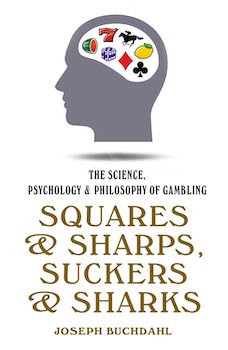
Joseph Buchdahl
Summary
An analysis of the science, psychology and philosophy of gambling.
Takeaway
Gambling is the speculation on the future that can take on different forms such as casino games, sports betting, and financial investing. Outcomes in these areas are hard to predict and it is even harder to make money from it against benchmarks that encapsulate the collective information of large crowds. Gamblers often underestimate the randomness that determine gambling outcomes and attribute positive outcomes to their own ability to predict the future.
Despite the fact that gambling is only lucrative for a negligible number of skilled gamblers, people continue to gamble. This might be related to the human desire to explain and control outcomes to instill a sense of certainy in an uncertain world.
Quotes
“According to this hypothesis, if reward uncertainty was not a source of motivation most predictive behaviours would extinguish because of the high failure rate. In other words, allowing an animal to persevere in a task is only possible if its behavior is motivated by a lack of predictability rather than the reward itself."
“If the purpose of gambling is to achieve authority over uncertainty, to feel in control of one’s destiny, surely everyone who plays sensibly and reasonably is a winner."
“Where luck is dominant, there is very little connection between the process and the outcome. If all you care about is outcomes, you’re liable to draw erroneous conclusions. On the contrary, don’t study winners to see what caused them; study the process to see whether it consistently led to success."

Author
David Goggins
Summary
The personal story of former Navy SEAL David Goggins who overcame traumatic experiences to become a successful soldier and athlete.
Takeaways
Most people do not know what they are truly capable of and resist challenging themselves physically and mentally to stretch the limits of their potential.
Unlocking this potential requires hard work and dedicated exposure to uncomfortable experiences and pain to “callous” the mind and become mentally strong.
Quotes
“By the time I graduated, I knew that the confidence I’d managed to develop didn’t come from a perfect family or God-given talent. It came from personal accountability which brought me self-respect, and self-respect will always light a way forward."
“A true leader stays exhausted, abhors arrogance, and never looks down on the weakest link. He fights for his men and leads by example."
“Starting at zero is a mindset that says my refrigerator is never full, and it never will be. We can always become stronger and more agile, mentally and physically. We can always become more capable and more reliable. Since that’s the case we should never feel that our work is done. There is always more to do."
Author
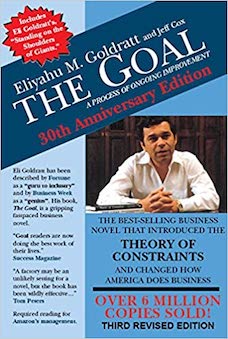
Eliyahu M. Goldratt
Summary
The story of a plant manager who discovers the benefit of systematically assessing the processing bottlenecks instead of relying on conventional wisdom.
Takeaways
Instead of relying on conventional wisdom, it is crucial to deeply reflect on the goal of an operation or organization and take a scientific and systematic approach to explore the factors (bottlenecks or constraints) that prevent us from reaching it.
The following process can serve as a blueprint to work towards achieving any goal.
- Identify the system’s constraint.
- Decide how to exploit the system’s constraint.
- Subordinate everything else to the above decisions.
- Elevate the system’s constraint.
- If in the previous steps a constraint has been broken, go back to step 1, but do not allow inertia to cause a system constraint.
Quotes
“Finally, and most importantly, I wanted to show that we can all be outstanding scientists. The secret of being a good scientist, I believe, lies not in our brain power. We have enough. We simply need to look at reality and think logically and precisely about what we see. The key ingredient is to have the courage to face inconsistencies between what we see and deduce and the way things are done."
“I stop and look at him. “What are we asking for? For the ability to answer three simple questions: ‘what to change?’, ‘what to change to?’, and ‘how to cause the change?’ Basically what we are asking for is the most fundamental abilities one would expect from a manager. Think about it. If a manager doesn’t know how to answer those three questions, is he or she entitled to be called manager?”
“The lesson that Shewhart brought to manufacturing from Physics, and Deming made known worldwide, is that trying to be more accurate than the noise (in our case, trying to use sophisticated algorithms that consider every possible parameter in an environment of high variability) does not improve things but makes them worse—the results will most certainly not be an improvement but a deterioration in due-date performance."
Author
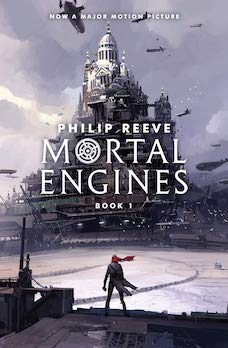
Philip Reeve
Summary
The fictional tale of traveling cities and their residents that battle for survival in a distant future.
Takeaways
Devotion to an ideology can be a strong motivator but also a destructive force. The actions of the characters are driven by their dedication to their way of living and their role in a world that leaves little room for exploring alternative ideas.
Quotes
“But he mustn’t feel sorry for them: it was natural that cities ate towns, just as the towns ate smaller towns and smaller towns snapped up the miserable static settlements. That was Municipal Darwinism, and it was the way the world had worked for hundreds of years, ever since the great engineer Nikolas Quirke had turned London into the first Traction City."
“You aren’t a hero, and I’m not beautfiful, and we probably won’t live happily ever after,” she said. “But we’re alive, and together, and we’re going to be all right."